Ground All Drones is a committee of Women Against Military Madness (WAMM) created to address the use of drones, particularly armed drones. Drones are developed worldwide, not only by the U.S. but by other nations as well. In the U.S.unarmed surveillance drones could be used to spy on citizens, a clear violation of our Fourth Amendment Rights. The current focus of this committee is on the use of weaponized drones.

Wednesday, August 8, 2018

Impressive.

Watch as Nearly 1,000 Drones Come Together to Make TIME's New Cover

This issue of TIME’s cover is unlike any in the magazine’s 95-year history.
Working with Intel, the cover was made by using 958 of the company’s Shooting Star™ drones to create the iconic TIME logo and red border in midair over California.
Intel’s drones, which you may have seen during the Winter Olympics, appear as dots in the sky and can be pre-programmed to create all manner of recognizable shapes and designs.

Drones Are Here to Stay. Get Used to It

May 31, 2018
When Hurricane Maria hit Puerto Rico last September, it ravaged the island’s electrical grid and communications systems. For weeks, many of the approximately 5 million Puerto Ricans living in the mainland U.S. were unable to reach their loved ones. While recovery groups worked to restore power and deliver aid, cell providers scrambled to repair their networks. To get its service back up and running, AT&T tried something new: the Flying COW, a tethered drone that beamed mobile data signals up to 40 miles in all directions.

“As soon as we turned it on, people just started connecting to it instantly,” says Art Pregler, AT&T’s Unmanned Aircraft Systems program director. His team operated the Flying COW, short for “cell on wheels,” from the parking lot of a Walmart on the island, which provided the Internet connection for the airborne cell tower.

With any technology, there are certain inflection points when it goes from being something perpetually in the near future to being a part of everyday life. For years, drones have been hovering on the cusp—used by militaries and relatively small numbers of hobbyists but not part of the larger culture. The U.S. military ushered in the drone age in 2001, when it began using the unmanned, remotely piloted technology to target al-Qaeda leaders in the wilds of Afghanistan. Drones have since become a key part of the military’s arsenal, and their use in conflict zones around the world has expanded under both the Obama and Trump Administrations. Civilian uses, however, have long been more promise than reality.

That’s finally changing. Some 3 million drones were sold worldwide in 2017, and more than 1 million drones are registered for U.S. use with the Federal Aviation Administration. (Most store-bought drones have to be registered with the FAA.) These consumer drones can fly vertically, like helicopters, and are similar to remote-controlled airplanes but with more sophisticated technology such as GPS, wi-fi and obstacle-avoidance sensors. They’re being used by tech-savvy farmers to monitor and spray crops, by researchers to measure environmental pollution and by Hollywood studios to capture action-packed footage for blockbuster movies. Drones are even saving lives, as first responders in places like Menlo Park, Calif., use them to coordinate operations and search for missing hikers. (Sixty-five people have been rescued by drones, by one estimate.) And of course, drones are being flown by hundreds of thousands of amateurs, who use them for everything from taking vacation photos to buzzing around their local park.

While businesses used the first wave of drones to take overhead real estate photos and deliver pizza for public relations stunts, now companies are experimenting in ways that could dramatically change entire industries. Amazon is working on drones that could deliver packages within minutes, technology that could one day be used for time-sensitive health emergencies like organ shipments. Facebook is working with drones to beam Internet connectivity to isolated corners of the world; the energy giant Shell employs the technology to keep its network of offshore rigs running smoothly. Meanwhile, investors are pouring hundreds of millions of dollars into drone startups with names like Skycatch (which creates aerial maps) and Skydio (which makes video-recording drones that automatically track a subject). The drone business is heavily dominated by China. Roughly 72% of the global market is controlled by DJI, which is headquartered in Shenzhen, often referred to as the Silicon Valley of China.


All this investment raises both possibilities and concerns. Privacy advocates are worried about the unchecked growth of aerial surveillance. Drones have been used to smuggle drugs into prisons, and the U.S. military is spending hundreds of millions of dollars to develop methods to prevent them from becoming terrorists’ weapon of choice. Some people, concerned about protecting their privacy from high-flying cameras, have taken matters into their own hands, like a Kentucky man who said he saw one flying over his property in 2015, grabbed a gun and shot it down. (He later sold T-shirts labeled drone slayer.) DJI recently unveiled a way for authorities to identify aircraft in no-drone zones.

At least 122,000 people in the U.S. are now certified to fly drones professionally, according to the FAA, which sparked the drone explosion in 2016 when it simplified its process for allowing their commercial use. Small drones, often between the size of a soda can and that of a mini-fridge, are relatively cheap and easy to fly and can carry a variety of payloads, including high-resolution cameras and thermal-imaging gear.

The surge in drone use presents a challenge for regulators. The FAA rules governing drone operation, which include no flying outside a pilot’s line of sight, have been criticized by drone entrepreneurs for hampering a burgeoning industry. How can Amazon deliver your toothpaste with a drone if it has to stay within eyeshot of a pilot? The Department of Transportation is working with drone-flying companies in 10 states as it tries to strike a balance between safety and innovation, and groups like NASA are studying ways to safely integrate drones into an already crowded airspace. (U.S. commercial pilots report about 100 too-close-for-comfort encounters per month.)

Developments in artificial intelligence and automation will make it possible to operate massive drone fleets simultaneously, increasing efficiency and greatly expanding their capabilities. First responders envision highways lined with drones ready to zip lifesaving medicine to accident scenes. Global transportation firms are designing helicopter-size versions that could zip people around like flying taxis, Jetsons-style, without a pilot on board.

Like it or not, the sky above is about to become far busier.

View the TIME magazine special issue. Many more topics about DRONES.
Go To TIME Special Report: The Drone Era


Friday, May 25, 2018

TRUMP DRONES ON

How unpiloted aircraft expand the war on terror.

by


They are like the camel’s nose, lifting a corner of the tent. Don’t be fooled, though. It won’t take long until the whole animal is sitting inside, sipping your tea and eating your sweets. In countries around the world -- in the Middle East, Asia Minor, Central Asia, Africa, even the Philippines -- the appearance of U.S. drones in the sky (and on the ground) is often Washington’s equivalent of the camel’s nose entering a new theater of operations in this country’s forever war against “terror.” Sometimes, however, the drones are more like the camel's tail, arriving after less visible U.S. military forces have been in an area for a while.

Scrambling for Africa
AFRICOM, the Pentagon’s Africa Command, is building Air Base 201 in Agadez, a town in the nation of Niger. The $110 million installation, which officially opens later this year, will be able to house both C-17 transport planes and MQ-9 Reaper armed drones. It will soon become the new centerpiece in an undeclared U.S. war in West Africa. Even before the base opens, armed U.S. drones are already flying from Niger’s capital, Niamey, having received permission from the Nigerien government to do so last November.

Despite crucial reporting by Nick Turse and others, most people in this country only learned of U.S. military activities in Niger in 2017 (and had no idea that about 800 U.S. military personnel were already stationed in the country) when news broke that four U.S. soldiers had died in an October ambush there. It turns out, however, that they weren't the only U.S soldiers involved in firefights in Niger. This March, the Pentagon acknowledged that another clash took place last December between Green Berets and a previously unknown group identified as ISIS-West Africa. For those keeping score at home on the ever-expanding enemies list in Washington’s war on terror, this is a different group from the Islamic State in the Greater Sahara (ISGS), responsible for the October ambush. Across Africa, there have been at least eight other incidents, most of them in Somalia.

What are U.S. forces doing in Niger? Ostensibly, they are training Nigerien soldiers to fight the insurgent groups rapidly multiplying in and around their country. Apart from the uranium that accounts for over 70% of Niger’s exports, there’s little of economic interest to the United States there.

The real appeal is location, location, location. Landlocked Niger sits in the middle of Africa’s Sahel region, bordered by Mali and Burkina Faso on the west, Chad on the east, Algeria and Libya to the north, and Benin and Nigeria to the south. In other words, Niger has the misfortune to straddle a part of Africa of increasing strategic interest to the United States.

In addition to ISIS-West Africa and ISGS, actual or potential U.S. targets there include Boko Haram (born in Nigeria and now spread to Mali and Chad), ISIS and al-Qaeda in the Lands of the Islamic Maghreb (AQIM) in Libya, and Al Mourabitoun, based primarily in Mali.

At the moment, for instance, U.S. drone strikes on Libya, which have increasedunder the Trump administration, are generally launched from a base in Sicily. However, drones at the new air base in Agadez will be able to strike targets in all these countries.

Suppose a missile happens to kill some Nigerien civilians by mistake(not exactly uncommon for U.S. drone strikes elsewhere)? Not to worry: AFRICOM is covered. A U.S.-Niger Status of Forces Agreement guarantees that there won’t be any repercussions. In fact, according to the agreement, “The Parties waive any and all claims... against each other for damage to, loss, or destruction of the other’s property or injury or death to personnel of either Party’s armed forces or their civilian personnel.” In other words, the United States will not be held responsible for any “collateral damage” from Niger drone strikes. Another clause in the agreement shields U.S. soldiers and civilian contractors from any charges under Nigerien law.

The introduction of armed drones to target insurgent groups is part of AFRICOM’s expansion of the U.S. footprint on a continent of increasing strategic interest to Washington. In the nineteenth and early twentieth centuries, European nations engaged in the “scramble for Africa," a period of intense and destructive competition for colonial possessions on the continent. In the post-colonial 1960s and 1970s, the United States and the Soviet Union vied for influence in African countries as diverse as Egypt and what is now the Democratic Republic of the Congo (DRC).

Today, despite AFRICOM’s focus on the war on terror, the real jockeying for influence and power on the continent is undoubtedly between this country and the People’s Republic of China. According to the Council on Foreign Relations, “China surpassed the United States as Africa’s largest trade partner in 2009” and has never looked back. “Beijing has steadily diversified its business interests in Africa,” the Council’s 2017 backgrounder continues, noting that from Angola to Kenya,

“China has participated in energy, mining, and telecommunications industries and financed the construction of roads, railways, ports, airports, hospitals, schools, and stadiums. Investment from a mixture of state and private funds has also set up tobacco, rubber, sugar, and sisal plantations... Chinese investment in Africa also fits into Chinese President Xi Jinping’s development framework, ‘One Belt, One Road.’”

For example, in a bid to corner the DRC’s cobalt and copper reserves (part of an estimated $24 trillion in mineral wealth there), two Chinese companies have formed Sicomines, a partnership with the Congolese government’s national mining company. The Pulitzer Center reports that Sicomines is expected “to extract 6.8 million tons of copper and 427,000 tons of cobalt over the next 25 years.” Cobalt is essential in the manufacture of today’s electronic devices -- from cell phones to drones -- and more than half of the world’s supply lies underground in the DRC.

Even before breaking ground on Air Base 201 in Niger, the United States already had a major drone base in Africa, in the tiny country of Djibouti in the Horn of Africa, across the Gulf of Aden from Yemen. From there, the Pentagon has been directing strikes against targets in Yemen and Somalia. As AFRICOM commander Gen. Thomas Waldhauser told Congress in March, "Djibouti is a very strategic location for us." Camp Lemonnier, as the base is known, occupies almost 500 acres near the Djibouti-Ambouli International Airport. U.S. Central Command, Special Operations Command, European Command, and Transportation Command all use the base. At present, however, it appears that U.S. drones stationed in Djibouti and bound for Yemen and Somalia take off from nearby Chabelley Airfield, as Bard College's Center for the Study of the Drone reports

To the discomfort of the U.S. military, the Chinese have recently established their first base in Africa, also in Djibouti, quite close to Camp Lemonnier. That country is also horning in on potential U.S. sales of drones to other countries. IndonesiaSaudi Arabia, and the United Arab emirates are among U.S. allies known to have purchased advanced Chinese drones.

The Means Justify the End?
From the beginning, the CIA’s armed drones have been used primarily to kill specific individuals. The Bush administration launched its global drone assassination program in October 2001 in Afghanistan, expanded it in 2002 to Yemen, and later to other countries. Under President Barack Obama, White House oversight of such assassinations only gained momentum (with an official “kill list” and regular “terror Tuesday” meetings to pick targets). The use of drones expanded 10-fold, with growing numbers of attacks in Pakistan, Yemen, Libya, and Somalia, as well as in the Afghan, Iraqi, and Syrian war zones. Early on, targets were generally people identified as al-Qaeda leaders or “lieutenants.” In later years, the kill lists grew to include supposed leaders or members of a variety of other terror organizations, and eventually even unidentified people engaged in activities that were to bear the “signature” of terrorist activity.

But those CIA drones, destructive as they were (leaving civilians dead, including children, in their wake) were just the camel’s nose -- a way to smuggle in a major change in U.S. policy. We’ve grown so used to murder by drone in the last 17 years that we’ve lost sight of an important fact: such assassinations represented a fundamental (and unlawful) change in U.S. military strategy. Because unpiloted airplanes eliminate the physical risk to American personnel, the United States has embraced a strategy of global extrajudicial executions: presidential assassinations on foreign soil.

It’s a case of the means justifying the end. The drones work so well at so little cost (to us) that it must be all right to kill people with them.

Successive administrations have implemented this strategic change with little public discussion. Critiques of the drone program tend to focus -- not unreasonably -- on the many additional people (like family members) who are injured or die along with the intended targets, and on civilians who should never have been targets in the first place. But few critics point out that executing foreign nationals without trial in other countries is itself wrong and illegal under U.S. law, as well as that of other countries where some of the attacks have taken place, and of course, international law.
How have the Bush, Obama, and now Trump administrations justified such killings? The same way they justified the expansion of the war on terror itself to new battle zones around the world -- through Congress’s September 2001 Authorization for the Use of Military Force (AUMF). That law permitted the president

“to use all necessary and appropriate force against those nations, organizations, or persons he determines planned, authorized, committed, or aided the terrorist attacks that occurred on September 11, 2001, or harbored such organizations or persons, in order to prevent any future acts of international terrorism against the United States by such nations, organizations or persons.”

Given that many of the organizations the United States is targeting with drones today didn’t even exist when that AUMF was enacted and so could hardly have "authorized" or "aided" in the 9/11 attacks, it offers, at best, the thinnest of coverage indeed for such a worldwide program.

Droning On and On
George W. Bush launched the CIA’s drone assassination program and that was just the beginning. Even as Barack Obama attempted to reduce the number of U.S. ground troops in Iraq and Afghanistan, he ramped up the use of drones, famously taking personal responsibility for targeting decisions. By some estimates, he approved 10 times as many drone attacks as Bush.

In 2013, the Obama administration introduced new guidelines for drone strikes, supposedly designed to guarantee with “near certainty” the safety of civilians. Administration officials also attempted to transfer most of the operational responsibility for drone attacks from the CIA to the military’s only-slightly-less-secretive Joint Special Operations Command (JSOC). Although the number of CIA strikes did drop, the Agency remained in a position to rev up its program at any time, as the Washington Post reported in 2016:

“U.S. officials emphasized that the CIA has not been ordered to disarm its fleet of drones, and that its aircraft remain deeply involved in counterterrorism surveillance missions in Yemen and Syria even when they are not unleashing munitions.”

It’s indicative of how easily drone killings have become standard operating procedure that, in all the coverage of the confirmation hearings for the CIA’s new director, Gina Haspel, there was copious discussion of the Agency’s torture program, but not a public mention of, let alone a serious question about, its drone assassination campaign. It’s possible the Senate Intelligence Committee discussed it in their classified hearing, but the general public has no way of knowing Haspel’s views on the subject.

However, it shouldn’t be too hard to guess. It’s clear, for instance, that President Trump has no qualms about the CIA’s involvement in drone killings. When he visited the Agency’s headquarters in Langley, Virginia, the day after his inauguration, says the Post, “Trump urged the CIA to start arming its drones in Syria. ‘If you can do it in 10 days, get it done,’ he said.” At that same meeting, CIA officials played a tape of a drone strike for him, showing how they’d held off until the target had stepped far enough away from the house that the missile would miss it (and so its occupants). His only question: “Why did you wait?”

You may recall that, while campaigning, the president told Fox News that the U.S. should actually be targeting certain civilians. “The other thing with the terrorists,” he said, “is you have to take out their families, when you get these terrorists, you have to take out their families. They care about their lives, don't kid yourself. When they say they don't care about their lives, you have to take out their families.” In other words, he seemed eager to make himself a future murderer-in-chief.

How, then, has U.S. drone policy fared under Trump? The New York Times has reported major changes to Obama-era policies. Both the CIA’s and the military’s “kill lists” will no longer be limited to key insurgent leaders, but expanded to include “foot-soldier jihadists with no special skills or leadership roles.” The Times points out that this “new approach would appear to remove some obstacles for possible strikes in countries where Qaeda- or Islamic State-linked militants are operating, from Nigeria to the Philippines.” And no longer will attack decisions only be made at the highest levels of government. The requirement for having a “near certainty” of avoiding civilian casualties -- always something of a fiction -- officially remains in place for now, but we know how seriously Trump takes such constraints.

He’s already overseen the expansion of the drone wars in other ways. In general, that “near certainty” constraint doesn’t apply to officially designated war zones (“areas of active hostility”), where the lower standard of merely avoiding unnecessary civilian casualties prevails. In March 2017, Trump approved a Pentagon request to identify large parts of Yemen and Somalia as areas of “active hostility,” allowing leeway for far less carefully targeted strikes in both places. At the time, however, AFRICOM head General Thomas D. Waldhauser said he would maintain the “near certainty” standard in Somalia for now (which, as it happens, hasn’t stopped Somali civilians from dying by drone strike).

Another change affects the use of drones in Pakistan and potentially elsewhere. Past drone strikes in Pakistan officially targeted people believed to be “high value” al-Qaeda figures, on the grounds that they (like all al-Qaeda leaders) represented an “imminent threat” to the United States. However, as a 2011 Justice Department paper explained, imminence is in the eye of the beholder: “With respect to al-Qaeda leaders who are continually planning attacks, the United States is likely to have only a limited window of opportunity within which to defend Americans.” In other words, once identified as an al-Qaeda leader or the leader of an allied group, you are by definition “continually planning attacks” and always represent an imminent danger, making you a permanentlegitimate target.

Under Trump, however, U.S. drones are not only going after those al-Qaeda targets permitted under the 2001 AUMF, but also targeting Afghan Taliban across the border in Pakistan. In other words, these drone strikes are not a continuation of counterterrorism as envisioned under the AUMF, but rather an extension of a revitalized U.S. war in Afghanistan. In general, the law of war allows attacks on a neutral country’s territory only if soldiers chase an enemy across the border in “hot pursuit.” So the use of drones to attack insurgent groups inside Pakistan represents an unacknowledged escalation of the U.S. Afghan War. Another corner of the tent lifted by the camel’s nose?

Transparency about U.S. wars in general, and airstrikes in particular, has also suffered under Trump. The administration, for instance, announced in March that it had used a drone to kill “Musa Abu Dawud, a high-ranking official in al-Qaeda in the Islamic Maghreb,” as the New York Times reported. However, the Times continued, “questions about whether the American military, under the Trump administration, is blurring the scope of operations in Africa were raised... when it was revealed that the U.S. had carried out four airstrikes in Libya from September to January that the Africa Command did not disclose at the time.”

Similarly, the administration has been less than forthcoming about its activities in Yemen. As the Business Insider reports (in a story updated from the Long War Journal), the U.S. has attacked al-Qaeda in the Arabian Peninsula (AQAP) there repeatedly, but “of the more than 114 strikes against AQAP in Yemen, CENTCOM has only provided details on four, all of which involved high value targets.” Because Trump has loosened the targeting restrictions for Yemen, it’s likely that the other strikes involved low-level targets, whose identity we won’t know.

Just Security, an online roundtable based at New York University, reports the total number of airstrikes there in 2017 as 120. They investigated eight of these and “found that U.S. operations were responsible for the deaths of at least 32 civilians -- including 16 children and six women -- and injured 10 others, including five children.” Yemeni civilians had a suggestion for how the United States could help them avoid becoming collateral damage: give them “a list of wanted individuals. A list that is clear and available to the public so that they can avoid targeted individuals, protect their children, and not allow U.S. targets to have a presence in their areas.”

A 2016 executive order requires that the federal director of national intelligence issue an annual report by May 1st on the previous year’s civilian deaths caused by U.S. airstrikes outside designated “active hostility” zones. As yet, the Trump administration has not filed the 2017 report.

Bigger and Better Camels Coming Soon to a Tent Near You
This March, a jubilant Fox News reported that the Marine Corps is planning to build a fancy new drone, called the MUX, for Marine Air Ground Task Force Unmanned Aircraft System-Expeditionary. This baby will sport quite a set of bells and whistles, as Fox marveled:

“The MUX will terrify enemies of the United States, and with good reason. The aircraft won't be just big and powerful: it will also be ultra-smart. This could be a heavily armed drone that takes off, flies, avoids obstacles, adapts and lands by itself -- all without a human piloting it.”
In other words, “the MUX will be a drone that can truly run vital missions all by itself.”

Between pulling out of the Iran agreement and moving the U.S. embassy in Israel to Jerusalem, Trump has made it clear that -- despite his base’s chants of “Nobel! Nobel!” -- he has no interest whatsoever in peace. It looks like the future of the still spreading war on terror under Trump is as clear as MUX.

 © 2018 TomDispatch.com
Rebecca Gordon
Rebecca Gordon is the author of the new book American Nuremberg: The U.S. Officials Who Should Stand Trial for Post-9/11 War Crimes and previously, Mainstreaming Torture: Ethical Approaches in the Post-9/11 United States. She teaches in the philosophy department at the University of San Francisco. She is a member of the War Times/Tiempo de Guerras collective. You can contact her through the Mainstreaming Torture website.


Friday, February 2, 2018

The kill chain: inside the unit that tracks targets for US drone wars

Amid Kansas bean fields military analysts watch live video of far-off suspects’ lives … and mark them for death. The killings, and accompanying civilian casualties, take an emotional toll


In a dimly lit room at McConnell air force base in south central Kansas, analysts from a national guard intelligence reconnaissance surveillance group watch live drone surveillance video coming from war zones in the Middle East.

During combat, the analysts become part of a “kill chain” – analyzing live drone video, then communicating what they see – in instant-message chat with jet fighter pilots, operators of armed Predator and Reaper drones, and ground troops.

 
A drone’s eye view of a target in the desert. The ‘kill chain’ links video analysts, jet fighter pilots and operators of armed drones.
Photograph: Main_sail/Getty Images/iStockphoto


They carry out drone warfare while sitting thousands of miles from battlefields. They don’t fly the drones and don’t fire the missiles. They video-stalk enemy combatants, and tell warfighters what they see. The work, they say, helps kill terrorists, including from Isis.

The group does this work in the middle of America, at an air base surrounded by flat cow pastures and soybean fields. The 184th Intelligence Wing of the Kansas air national guard, started this work about 2002. Until last year, most people in Kansas knew nothing about their role in drone warfare.

The work is top secret. They say that they see things in those drone images that no one wants to see. Sometimes, it’s terrorists beheading civilians. Sometimes it’s civilians dying accidentally in missions that the Kansans help coordinate.

They agonize over those deaths. The most frequently heard phrase in drone combat, one airman says, is: “Don’t push the button.”

“You see [enemy combatants] kiss their kids goodbye, and kiss their wives goodbye, and then they walk down the street,” said a squadron chief master sergeant. “As soon as they get over that hill, the missile is released.”

The Americans wait to fire, he says, “because we don’t want the family to see it”.

‘Worst year for civilians’

Drone war critics describe it as depersonalized killing, done with collateral costs unknown. Those critics, including those studying civilian deaths on the ground in the Middle East, say that actual deaths exceed by thousands the total number admitted to by the US and its coalition allies. In a statement on their website, Airwars.org said: “By any measure, 2017 has been the worst year for civilians in the fight against Isis, as battles moved deep into Iraqi and Syrian cities.” Despite the coalition’s insistence that it was waging “the most precise war in history”, Airwars estimates that at least 3,875 non-combatants were killed by coalition actions during 2017 to November.

In Afghanistan, Pakistan, Somalia and Yemen, nearly 10,000 people are estimated to have died in 4,413 US strikes since about 2002, according to the watchdog Bureau of Investigative Journalism. The bureau estimates that as many as 1,488 were civilians, including up to 331 children.

Reporters for the New York Times Magazine, in a November story called The Uncounted, wrote that they had spent 18 months personally visiting 150 coalition strike sites in Iraq. They concluded that one in five strikes kills civilians – a toll they say is 31 times higher than military estimates.

Finish reading this article on the Guardian's website click here. 


Wednesday, November 29, 2017

Star Tribune - Letter of the Day

Reminder that an activist's work can be done at home - writing a letter, posting on facebook, or even flying a kite! Here is GAD member's letter to the newspaper:

The definitions of  “sovereignty” and “the responsibility to protect,” referenced by Ellen J. Kennedy in her Oct. 30 commentary “ ‘Sovereignty’ is a cop-out for turning away from global needs,” can be, and have been, politicized and twisted in devastating ways. I’m thinking specifically about the use of weaponized drones by U.S. military and CIA programs, which have assassinated people in seven sovereign nations (Afghanistan, Iraq, Libya, Pakistan, Somalia, Syria, Yemen) and have killed nontargeted people of all ages — as many as 6,000 to 9,000 lives ended, as reported by the independent Bureau of Investigative Journalism. While the colleagues and extended families of the dead might pledge unending retaliation against the U.S., exactly who has been “protected” and who is “responsible”?
Lucia Wilkes Smith, St. Louis Park, MN

Saturday, November 4, 2017

Trump Is Killing Record Numbers of Civilians

A MQ-1 Predator over Tikrit, Iraq. (Photo: Terry Moore / Stocktrek Images)
Tuesday, October 31, 2017
By Marjorie Cohn,
Truthout | News Analysis

During the 2016 presidential campaign, Donald Trump advocated killing innocent families of suspected terrorists. "When you get these terrorists, you have to take out their families," he declared. Besides the immorality of killing innocents, the targeting of civilians violates the Geneva Conventions.

The George W. Bush administration unlawfully detained and tortured suspected terrorists. Determined not to send more suspects to Guantánamo, Barack Obama's administration illegally assassinated them with drones and other methods, killing many civilians in the process.

Now the Trump administration is killing record numbers of civilians and weakening the already-flimsy targeted killing rules Obama put in place.

To read more stories like this, visit Human Rights and Global Wrongs.

In 2013, the Obama administration promulgated a set of requirements regarding targeted killings "outside areas of active hostilities" in a Presidential Policy Guidance (PPG).

The New York Times reported on September 21, 2017, that Trump's national security advisers proposed watering down Obama's PPG. These recommendations to Trump are called Principles, Standards and Procedures, or PSP. On October 29, the Times reported, "Two government officials said Mr. Trump had recently signed his new rules for such kill-or-capture counterterrorism operations, without major changes" to the PSP.

Obama mounted both "personality strikes" -- aimed at named suspected terrorists -- and "signature strikes" -- in which all military-age men in an area of suspicious activity could be killed. Signature strikes are often called "crowd killings" because those perpetrating the attacks don't even know whom they are killing. Trump has presumably continued these two types of strikes.

The PPG required that the target pose a continuing, imminent threat to US persons. There is no indication that Trump's new rules have changed this requirement. Moreover, even under Obama, a 2011 Department of Justice white paper said that a US citizen could be killed even when there was no "clear evidence that a specific attack on US persons and interests will take place in the immediate future." Obama presumably set a lower bar for killing non-citizens.

Obama's rules also mandated near certainty that an identified "high-value terrorist" or other lawful terrorist target is present before taking a strike. One official told the Times that the administration "reduced the required level of confidence that the intended target was present in a strike zone from 'near certainty' to 'reasonable certainty.'" Signature strikes don't target named individuals. Under the new Trump rules, targets would no longer be limited to high-value terrorists, but could also include foot soldiers with no leadership roles.

During the Obama administration, targeting decisions were made at the highest levels of government and the president reportedly had the final say about who would be assassinated. Under the PSP, however, these determinations would not require vetting by top administration officials, and could be made by commanders in the field.

Trump advisers recommended maintaining the PPG's requirement of near certainty that civilians would not be injured or killed, and the administration agreed, according to the Times.

In spite of the PPG, the Obama administration killed many civilians. Obama's Office of the Director of National Intelligence (ODNI) reported killing between 64 and 116 non-combatants "outside areas of active hostilities" from January 2009 to December 2015. That encompassed Pakistan, Yemen, Somalia and Libya. Civilian deaths in Afghanistan, Iraq and Syria were not included. And even for the included countries, the ODNI figures could be low: The London-based Bureau of Investigative Journalism estimated between 380 and 801 civilians killed outside areas of active hostilities during the same period.

Even before relaxing the rules, drone strikes and other targeted killings outside areas of active hostilities have already increased from one every 5.4 days during the Obama administration, to one every 1.25 days under Trump, Micah Zenko of the Council on Foreign Relations reported.

Trump granted increased authority to the CIA and the Pentagon to conduct drone strikes. He also loosened the targeted killing rules in large areas of Yemen and Somalia by designating them "areas of active hostilities."

In March alone, the Trump administration killed 1,000 civilians in Iraq and Syria, according to Airwars, a non-governmental organization that monitors civilian casualties from airstrikes.

We can expect to see increasing numbers of civilian deaths as Trump continues the "war on terror" he inherited from his predecessors. Since Bush launched this war after 9/11, we have become more vulnerable to terrorism. Civilian killings heighten anger toward the United States and lead to stepped-up recruitment of those who would do us harm.

Copyright, Truthout. 

Marjorie Cohn

Marjorie Cohn is professor emerita at Thomas Jefferson School of Law, former president of the National Lawyers Guild, deputy secretary general of the International Association of Democratic Lawyers and a member of the national advisory board of Veterans for Peace. The second, updated edition of her book, Drones and Targeted Killing: Legal, Moral, and Geopolitical Issues, will be published in November. Visit her website: MarjorieCohn.com. Follow her on Twitter: @MarjorieCohn.

Tuesday, September 19, 2017

C.I.A. Wants Authority to Conduct Drone Strikes in Afghanistan for the First Time

 New York Times

WASHINGTON — The C.I.A. is pushing for expanded powers to carry out covert drone strikes in Afghanistan and other active war zones, a proposal that the White House appears to favor despite the misgivings of some at the Pentagon, according to current and former intelligence and military officials.

If approved by President Trump, it would mark the first time the C.I.A. has had such powers in Afghanistan, expanding beyond its existing authority to carry out covert strikes against Al Qaeda and other terrorist targets across the border in Pakistan.

The changes are being weighed as part of a broader push inside the Trump White House to loosen Obama-era restraints on how the C.I.A. and the military fight Islamist militants around the world. The Obama administration imposed the restrictions in part to limit civilian casualties, and the proposed shift has raised concerns among critics that the Trump administration would open the way for broader C.I.A. strikes in such countries as Libya, Somalia and Yemen, where the United States is fighting the Islamic State, Al Qaeda or both.

Until now, the Pentagon has had the lead role for conducting airstrikes — with drones or other aircraft — against militants in Afghanistan and other conflict zones, such as Somalia and Libya and, to some extent, Yemen. The military publicly acknowledges its strikes, unlike the C.I.A., which for roughly a decade has carried out its own campaign of covert drone strikes in Pakistan that were not acknowledged by either country, a condition that Pakistan’s government has long insisted on.

But the C.I.A.’s director, Mike Pompeo, has made a forceful case to Mr. Trump in recent weeks that the Obama-era arrangement needlessly limited the United States’ ability to conduct counterterrorism operations, according to the current and former officials, who would not be named discussing internal debates about sensitive information. He has publicly suggested that Mr. Trump favors granting the C.I.A. greater authorities to go after militants, though he has been vague about specifics, nearly all of which are classified.

“When we’ve asked for more authorities, we’ve been given it. When we ask for more resources, we get it,” Mr. Pompeo said this week on Fox News.

He said that the agency was hunting “every day” for Al Qaeda’s leaders, most of whom are believed to be sheltering in the remote mountains that straddle the border between Afghanistan and Pakistan.
“If I were them, I’d count my days,” Mr. Pompeo said.

From the outset of his tenure at the C.I.A., Mr. Pompeo, a West Point graduate and former Army officer, has made clear that he favors pushing the agency to take on a more direct role in fighting militants. Afghanistan, the most active war zone in which the United States is fighting, makes sense as the place to start: In the past three years, the number of military drone strikes there has climbed, from 304 in 2015, to 376 last year, to 362 through the first eight months of this year.

The C.I.A., in comparison, has had little to do across the border in Pakistan, where there were three drone strikes last year and have been four so far this year, according to the Long War Journal published by the Foundation for Defense of Democracies.

“This is bureaucratic politics 101,” said Christine Wormuth, a former top Pentagon official. “The C.I.A. has very significant capabilities, and it wants to go use them.”

Spokesmen for the C.I.A. and the Defense Department declined to comment on the pending proposal, which involves delicate internal deliberations.

Defense Secretary Jim Mattis has not resisted the C.I.A. proposal, administration officials said, but other Pentagon officials question the expansion of C.I.A. authorities in Afghanistan or elsewhere, asking what the agency can do that the military cannot. Some Pentagon officials also fear that American troops on the ground in Afghanistan could end up bearing the burden of any C.I.A. strikes that accidentally kill civilians, because the agency will not publicly acknowledge those attacks. The military has also had to confront its own deadly mistakes in Afghanistan.

One senior Defense Department official said that the United States would gain little from having the C.I.A. carry out drone strikes alongside the military, and that it raised the question of whether it was an appropriate use of covert action.

A former senior administration official familiar with Mr. Pompeo’s position said that he views a division of labor with the Defense Department as an abrogation of the C.I.A.’s authorities.
Mr. Pompeo’s argument seems to be carrying the day with Mr. Trump, who has struck a bellicose tone in seeking to confront extremist groups in Afghanistan, including Al Qaeda, the Islamic State and the Haqqani network, a faction of the Taliban.

In Mr. Trump’s speech last month outlining his policy for South Asia, including Afghanistan, the president promised that he would loosen restrictions on American soldiers to enable them to hunt down terrorists, whom he labeled “thugs and criminals and predators, and — that’s right — losers.”
“The killers need to know they have nowhere to hide, that no place is beyond the reach of American might and American arms,” the president said. “Retribution will be fast and powerful.”

Mr. Pompeo may have a potentially important ally: Gen. John W. Nicholson Jr., the top commander in Afghanistan, who reportedly favors any approach to train more firepower on the array of foes of Afghan security forces and the 11,000 or so American troops advising and assisting them.

Mr. Trump has already authorized Mr. Mattis to deploy more troops to Afghanistan. Some 4,000 reinforcements will allow American officers to more closely advise Afghan brigades, train more Afghan Special Operations forces and call in American firepower.

Among the chief targets for the C.I.A. in Afghanistan would be the Haqqani network, whose leader is now the No. 2 in the Taliban and runs its military operations. The Haqqanis have been responsible for many of the deadliest attacks on Afghanistan’s capital, Kabul, in the war and are known for running a virtual factory in Pakistan that has steadily supplied suicide bombers since 2005.

Despite their objections, Defense Department officials say they are now somewhat resigned to the outcome and are working out arrangements with the C.I.A. to ensure that United States forces, including Special Operations advisers, are not accidentally targeted, officials said.

Beyond the military, critics see the proposal as another attempt to expand the C.I.A.’s drone wars without answering longstanding questions about whether American spies should be running military-style operations in the shadows.

“One of the things we learned early on in Afghanistan and Iraq was the importance of being as transparent as possible in discussing our military operations,” said Luke Hartig, a senior director for counterterrorism at the National Security Council during the Obama administration.

“Why we took the specific action, who all was killed or injured in the operation, what we were going to do if we had inadvertently killed civilians or damaged property,” he continued. “I don’t know what the Trump administration is specifically considering in Afghanistan, but if their new plans for the war decrease any of that transparency, that would be a big strategic and moral mistake.”

When John O. Brennan, a former top White House counterterrorism adviser, became C.I.A. director in late 2013, he announced an intention to ratchet back the paramilitary operations that have transformed the agency since the Sept. 11 attacks.

Mr. Brennan’s goal, he said during his confirmation hearings, was to refocus the agency on the traditional work of intelligence collection and espionage that had sometimes been neglected. During those hearings, Mr. Brennan obliquely criticized the performance of American spy agencies in providing intelligence and analysis of the Arab revolutions that began in 2009, and said the C.I.A. needed to cede some of its paramilitary role to the Pentagon.

In a speech in May 2013 in which he sought to redefine American policy toward terrorism, President Barack Obama expanded on that theme, announcing new procedures for drone operations, which White House officials said would gradually become the responsibility of the Pentagon.
But critics contended that effort, too, proved slow-going, and that Mr. Brennan did not push forcefully for moving all drone operations away from the C.I.A.

Now, with Mr. Pompeo in charge, the agency appears to be aggressively renewing its paramilitary role, and pushing limits on other forms of covert operations outside conflict zones, including in countries where no fighting is underway, such as Iran. A veteran C.I.A. officer viewed as the architect of the drone program was put in charge of the agency’s Iran operations this year, for instance, and Mr. Pompeo has made it clear that he believes the C.I.A. has a robust role to play in fighting militants.
“We broke the back of Al Qaeda,” he said at a public appearance in July, referring to the drone campaign inside Pakistan that decimated the militant network’s leadership ranks.

“We took down their entire network,” he said. “And that’s what we’re going to do again.”

DRONE WARS: Out of Sight Out of Mind Out of Control

This is from the UK, a great summary and list of resources and actions to take.
A 28 page download or read online.

INTRODUCTION:
Over the past fifteen years unmanned aerial vehicles commonly known as drones have risen from a fringe technology to becoming a key component of Western military power, with US, British and Israeli forces launching thousands of drone strikes across Asia, the Middle East and Africa. Drones have become one of the most used weapons in conventional wars, but are also being used far from any battlefield in so-called targeted killings to ‘take out’ those deemed to be a threat to security.

While military officials describe drones as ' the most precise and effective application of firepower in the history of armed conflict’, human rights organisations and journalists have documented that hundreds of innocent civilians have been killed in such strikes.

But armed drones are more than just a new weapon system, the latest in a long line of technological solutions to international security problems. Drones are at the forefront of the rehabilitation of the idea of war itself. Through using remote systems and precision weapons, we are being told, war is no longer the hell it once was. Such a narrative is extremely naïve and dangerous. Not only does it obscure the casualties and destruction caused by drone strikes, but it also means that when there is a political crisis the press and politicians demand we ‘send in the drones’ as there is no perceived cost in doing so.

The concept of remote ‘risk-free war’ through the use of armed drones means that military intervention is rapidly becoming one of the first options instead of the last. Besides the direct consequences, this also enables political leaders to sidestep addressing the underlying political and social causes of conflicts which in turn lessens the chances of achieving long-term just and sustainable solutions. 

This briefing highlights some of the key issues surrounding the growing use of armed drones, including: civilian casualties, the expansion of targeted killing and how drones lower the threshold for use of armed force.

As one of only a handful of countries currently using armed drones, the UK has both the responsibility and the opportunity to take a lead internationally on controlling their use, both in terms of setting high levels of transparency and accountability, but also putting in place strong controls internationally to prevent the proliferation of such systems. Armed drones and the growing acceptability of ‘risk free warfare’ is a real danger to global peace and security.

At this crucial time, it is vital that all who want the world to be a more just and secure place work together to ensure that we don’t allow armed drones to be out of sight, out of mind and out of control.

Wednesday, July 12, 2017

Drones Part of Current U.S. Air War Atrocity Born in the 1920s

Taken from KnowDrones article July 5, 2017

In the 1920s Winston Churchill bombed Iraqis who were resisting British rule.  The issue was oil. This established a policy that would lead to massive World War II bombing campaigns and now the vast aerial attack by the U.S. and its colonially-minded partners that is devastating the lives of millions of people across swaths of the Middle East and Afghanistan, and to a lesser degree Libya and Somalia. 

This linked article provides an extremely important analysis of the thinking behind the racist, 1920s British air war and how this thinking lives today in drone war as well as the overall U.S. aerial killing policy. http://www.bbc.com/news/magazine-29441383

In these remarkable - must watch - linked videos it is hard to see any difference between the ideas expressed by RAF pilots who bombed Iraqis in the 1920s and U.S. policy now.  The reports of the Iraqi witnesses to the RAF attacks are almost identical to the comments of victims of drone attacks now.

https://www.youtube.com/watch?v=8rrSaFvRBFU&t=76s
https://www.youtube.com/watch?v=nx-QgSa6cLA
https://www.youtube.com/watch?v=XKePRwarlXQ

It is impossible to know the full human and environmental cost of what can only be described as an atrocity of historic proportions, which includes bombing by B-52s, but information from Air Wars.org, the Bureau of Investigative Journalism and other sources suggest that the U.S.-led air aerial assault campaign across Syria, Iraq, Afghanistan, Yemen, Pakistan, Somalia and Libya, including assisting Saudi Arabia’s air attacks in Yemen, has caused:
  • At least 20,000 civilian deaths and tens of thousands more wounded.  (My estimate based on information in the above sources; I think this is very conservative.)
  • Hundreds of thousands, if not millions, of refugees.
  • Famine and cholera threatening more than 17 million in Yemen alone.
  • Massive destruction of homes, communities and infrastructure.   These photos of Mosul in Iraq can be taken in many, many places that are being subjected to “coalition” air attack.
 https://www.nytimes.com/2017/07/03/world/middleeast/mosul-civilians-escape-isis.html

U.S. drone operators have been a key part of this campaign, apparently involved in identifying targets for conventional bombers as well as undertaking their own attacks.  This extremely informative linked article speaks of drone operators working to minimize civilian casualties, but given what is happening, one can only wonder at this kind of commentary.

http://www.military.com/daily-news/2016/10/03/air-force-seeks-to-change-how-drone-pilots-train-fly.html

Tuesday, July 11, 2017

Informative links

Airwars.org maintains an extensive all-source database of known allegations in which civilians and friendly forces have been reported killed by the Coalition or Russia in Iraq and Syria. Airwars individual case studies include photographs, videos, names of the dead, and links to all known sources. These reports represent our best current understanding of events and are updated as new information becomes available. 

Older U.S. Air Force jets -- including the A-10 Thunderbolt II, eyed in recent years for retirement, and the F-15E Strike Eagle -- are leading the air war against the Islamic State, statistics show.
U.S. military fighter-attack jets, bombers and drones have dropped more than 67,000 bombs since the 2014 start of Operation Inherent Resolve, the Defense Department's mission against the Islamic State of Iraq and Syria, or ISIS, according to information provided by Air Forces Central Command.
Notably, fighter-attack aircraft released more than three times as many weapons as bombers did, the figures show. Drones dropped the least of any category of aircraft.

Military.com has the figures for the 10 types of U.S. aircraft flying combat sorties: F-15E Strike Eagle, 14,995 weapons released; A-10 Thunderbolt II, 13,856; B-1 Lancer, 9,195; F/A-18 Super Hornets, 8,920; F-16 Fighting Falcon, 7,679; B-52 Stratofortress, 5,041; MQ-1 Predator drone, 2,274; MQ-9 Reaper, 2,188; AV-8B, 1,650; and F-22, 1,535.
Broken down by aircraft type, fighter and attack planes dropped a total of 48,635 weapons, or 72 percent of the total; bombers released 14,236, or 21 percent; and drones dropped 4,462, or 7 percent, according to the statistics.

Friday, June 9, 2017

"Drone Warfare and the Cyborg Soldier: Margins of Masculinity"

"Drone Warfare and the Cyborg Soldier: Margins of Masculinity"
Tuesday, June 13, 2017, at 7:00 pm
East Side Freedom Library, 1105 Greenbrier Street, St. Paul, MN
Presentation by Suzanne Al-Kayali

Modern military power has ignited real and virtual changes as nations make war
and soldiers perceive themselves as warriors. The role of the soldier has
changed with the evolution of technologies, such as drones. Is the hyper-
masculine "be-all-you-can-be" soldier being replaced? Suzanne will discuss the
role of "masculinity" in contemporary warfare and the development of the new
"cyborg" soldier.
Suzanne Al-Kayali is the current director of WAMM. She earned her Master's
degree in Sociology with an emphasis in Women and Gender Studies from
Roosevelt University in Chicago.
FFI: WAMM Office 612-827-5364

Hosted by the WAMM Ground All Drones Committee

Thursday, June 8, 2017

Killer Drones and the Militarization of U.S. Foreign Policy

In the eyes of many around the world, diplomacy has taken a back seat to military operations in U.S. foreign policy. The drone program is a prime example.

The militarization of U.S. foreign policy certainly didn’t start with President Donald J. Trump; in fact, it goes back several decades. However, if Trump’s first 100 days in office are any indication, he has no intention of slowing down the trend.

During a single week in April, the Trump administration fired 59 Tomahawk missiles into a Syrian airfield, and dropped the largest bomb in the U.S. arsenal on suspected ISIS tunnels in Afghanistan. This 21,600-pound incendiary percussion device that had never been used in combat—the Massive Ordinance Air Blast or MOAB, colloquially known as the “Mother of All Bombs”—was used in the Achin district of Afghanistan, where Special Forces Staff Sergeant Mark De Alencar had been killed a week earlier. (The bomb was tested only twice, at Elgin Air Base, Florida, in 2003.)

To underscore the new administration’s preference for force over diplomacy, the decision to experiment with the explosive power of the mega-bomb was taken unilaterally by General John Nicholson, the commanding general of U.S. forces in Afghanistan. In praising that decision, Pres. Trump declared that he had given “total authorization” to the U.S. military to conduct whatever missions they wanted, anywhere in the world—which presumably means without consulting the interagency national security committee.

It is also telling that Pres. Trump chose generals for two key national security positions traditionally filled by civilians: the Secretary of Defense and the National Security Advisor. Yet three months into his administration, he has left unfilled hundreds of senior civilian governmental positions at State, Defense and elsewhere.


An Increasingly Shaky Ban

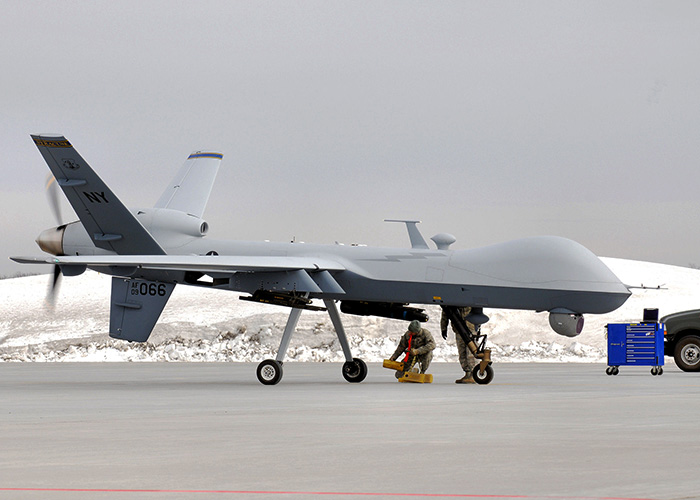
Members of the New York Air National Guard’s 1174th Fighter Wing Maintenance Group place chalks on a MQ-9 Reaper after it returned from a winter training mission at Wheeler Sack Army Airfield, Fort Drum, N.Y., Feb. 14, 2012.
Wikimedia Commons / Ricky Best
While Pres. Trump has not yet enunciated a policy on the subject of political assassinations, there has so far been no indication that he plans to change the practice of relying on drone killings established by his recent predecessors.

Back in 1976, however, President Gerald Ford set a very different example when he issued his Executive Order 11095. This proclaimed that “No employee of the United States government shall engage in, or conspire to engage in, political assassination.”

He instituted this prohibition after investigations by the Church Committee (the Senate Select Committee to Study Governmental Operations with Respect to Intelligence Activities, chaired by Sen. Frank Church, D-Idaho) and the Pike Committee (its House counterpart, chaired by Rep. Otis G. Pike, D-N.Y.) had revealed the extent of the Central Intelligence Agency’s assassination operations against foreign leaders in the 1960s and 1970s.

With a few exceptions, the next several presidents upheld the ban. But in 1986, President Ronald Reagan ordered an attack on Libyan strongman Muammar Gaddafi’s home in Tripoli, in retaliation for the bombing of a nightclub in Berlin that killed a U.S. serviceman and two German citizens and injured 229. In just 12 minutes, American planes dropped 60 tons of U.S. bombs on the house, though they failed to kill Gaddafi.

Twelve years later, in 1998, President Bill Clinton ordered the firing of 80 cruise missiles on al-Qaida facilities in Afghanistan and Sudan, in retaliation for the bombings of U.S. embassies in Kenya and Tanzania. The Clinton administration justified the action by asserting that the proscription against assassination did not cover individuals whom the U.S. government had determined were connected to terrorism.

Days after al-Qaida carried out its Sept. 11, 2001, attacks on the United States, President George W. Bush signed an intelligence “finding” allowing the Central Intelligence Agency to engage in “lethal covert operations” to kill Osama bin Laden and destroy his terrorist network. White House and CIA lawyers argued that this order was constitutional on two grounds. First, they embraced the Clinton administration’s position that E.O. 11905 did not preclude the United States’ taking action against terrorists. More sweepingly, they declared that the ban on political assassination did not apply during wartime.


Send in the Drones

The Bush administration’s wholesale rejection of the ban on targeted killing or political assassinations reversed a quarter-century of bipartisan U.S. foreign policy. It also opened the door to the use of unmanned aerial vehicles to conduct targeted killings (a euphemism for assassinations).
The U.S. Air Force had been flying unmanned aerial vehicles (UAVs), since the 1960s, but only as unmanned surveillance platforms. Following 9/11, however, the Department of Defense and the Central Intelligence Agency weaponized “drones” (as they were quickly dubbed) to kill both leaders and foot soldiers of al-Qaida and the Taliban.

The United States set up bases in Afghanistan and Pakistan for that purpose, but after a series of drone attacks that killed civilians, including a large group gathered for a wedding, the Pakistani government ordered in 2011 that the U.S. drones and U.S. military personnel be removed from its Shamsi Air Base. However, targeted assassinations continued to be conducted in Pakistan by drones based outside the country.

In 2009, President Barack Obama picked up where his predecessor had left off. As public and congressional concern increased about the use of aircraft controlled by CIA and military operators located 10,000 miles away from the people they were ordered to kill, the White House was forced to officially acknowledge the targeted killing program and to describe how persons became targets of the program.

Instead of scaling the program back, however, the Obama administration doubled down. It essentially designated all military-age males in a foreign strike zone as combatants, and therefore potential targets of what it termed “signature strikes.” Even more disturbing, it declared that strikes aimed at specific, high-value terrorists, known as “personality strikes,” could include American citizens.

That theoretical possibility soon became a grim reality. In April 2010, Pres. Obama authorized the CIA to “target” Anwar al-Awlaki, an American citizen and a former imam at a Virginia mosque, for assassination. Less than a decade before, the Office of the Secretary of the Army had invited the imam to participate in an interfaith service following 9/11. But al-Awlaki later became an outspoken critic of the “war on terror,” moved to his father’s homeland of Yemen, and helped al-Qaida recruit members.
The Bush administration’s wholesale rejection of the ban on targeted killing opened the door to the use of unmanned aerial vehicles to conduct targeted killings.
On Sept. 30, 2011, a drone strike killed al-Awlaki and another American, Samir Khan—who was traveling with him in Yemen. U.S. drones killed al-Awlaki’s 16-year-old son, Abdulrahman al- Awlaki, an American citizen, 10 days later in an attack on a group of young men around a campfire.

The Obama administration never made clear whether the 16-year-old son was targeted individually because he was al-Awlaki’s son or if he was the victim of a “signature” strike, fitting the description of a young militaryage male. However, during a White House press conference, a reporter asked Obama spokesman Robert Gibbs how he could defend the killings, and especially the death of a U.S.-citizen minor who was “targeted without due process, without trial.”

Gibbs’ response did nothing to help the U.S. image in the Muslim world: “I would suggest that you should have had a far more responsible father if they are truly concerned about the well-being of their children. I don’t think becoming an al-Qaida jihadist terrorist is the best way to go about doing your business.”
On Jan. 29, 2017, al-Awlaki’s 8-year-old daughter, Nawar al-Awlaki, was killed in a U.S. commando attack in Yemen ordered by Obama’s successor, Donald Trump.

Meanwhile, the media continued to report incidents of civilians being killed in drone strikes across the region, which frequently target wedding parties and funerals. Many inhabitants of the region along the Afghan-Pakistan border could hear the buzz of drones circling their area around the clock, causing psychological trauma for all those who live in the area, especially children.

The Obama administration was strongly criticized for the tactic of “double-tap”—hitting a target home or vehicle with a Hellfire missile, and then firing a second missile into the group that came to the aid of those who had been wounded in the first attack. Many times, those who ran to help rescue persons trapped inside collapsed buildings or flaming cars were local citizens, not militants.


An Increasingly Counterproductive Tactic

The rationale traditionally offered for using drones is that they eliminate the need for “boots on the ground”—whether members of the armed forces or CIA paramilitary personnel—in dangerous environments, thereby preventing loss of U.S. lives. U.S. officials also claim that the intelligence UAVs gather through lengthy surveillance makes their strikes more precise, reducing the number of civilian casualties. (Left unsaid, but almost certainly another powerful motivator, is the fact that the use of drones means that no suspected militants would be taken alive, thus avoiding the political and other complications of detention.)

Even if these claims are true, however, they do not address the impact of the tactic on U.S. foreign policy. Of broadest concern is the fact that drones allow presidents to punt on questions of war and peace by choosing an option that appears to offer a middle course, but actually has a variety of long-term consequences for U.S. policy, as well as for the communities on the receiving end.

By taking the risk of loss of U.S. personnel out of the picture, Washington policymakers may be tempted to use force to resolve a security dilemma rather than negotiating with the parties involved. Moreover, by their very nature, UAVs may be more likely to provoke retaliation against America than conventional weapons systems. To many in the Middle East and South Asia, drones represent a weakness of the U.S. government and its military, not a strength. Shouldn’t brave warriors fight on the ground, they ask, instead of hiding behind a faceless drone in the sky, operated by a young person in a chair many thousands of miles away?
Drones allow presidents to punt on questions of war and peace by choosing an option that appears to offer a middle course, but actually has a variety of long-term consequences for U.S. policy.
Since 2007, at least 150 NATO personnel have been the victims of “insider attacks” by members of the Afghan military and national police forces being trained by the coalition. Many of the Afghans who commit such “green on blue” killings of American personnel, both uniformed and civilian, are from the tribal regions on the border of Afghanistan and Pakistan where U.S. drone strikes have focused. They take revenge for the deaths of their families and friends by killing their U.S. military trainers.

Anger against drones has surfaced in the United States as well. On May 1, 2010, Pakistani-American Faisal Shahzad attempted to set off a car bomb in Times Square. In his guilty plea, Shahzad justified targeting civilians by telling the judge, “When the drone hits in Afghanistan and Iraq, they don’t see children, they don’t see anybody. They kill women, children; they kill everybody. They’re killing all Muslims.”

As of 2012 the U.S. Air Force was recruiting more drone pilots than pilots for traditional aircraft—between 2012 and 2014, they planned to add 2,500 pilots and support people to the drone program. That is nearly twice the number of diplomats the State Department hires in a two-year period.

Congressional and media concern over the program led to the Obama administration’s acknowledgment of the regular Tuesday meetings led by the president to identify targets for the assassination list. In the international media, “Terror Tuesdays” became an expression of U.S. foreign policy.


Not Too Late

To many around the world, U.S. foreign policy has been dominated for the past 16 years by military actions in the Middle East and South Asia, and large land and sea military exercises in Northeast Asia. On the world stage, American efforts in the areas of economics, trade, cultural issues and human rights appear to have taken a back seat to the waging of continuous wars.

Continuing the use of drone warfare to carry out assassinations will only exacerbate foreign distrust of American intentions and trustworthiness. It thereby plays into the hands of the very opponents we are trying to defeat.

During his campaign, Donald Trump pledged he would always put “America First,” and said he wanted to get out of the business of regime change. It is not too late for him to keep that promise by learning from his predecessors’ mistakes and reversing the continued militarization of U.S. foreign policy.

Ann Wright spent 29 years in the U.S. Army and Army Reserves, retiring as a colonel. She served 16 years in the Foreign Service in Nicaragua, Grenada, Somalia, Uzbekistan, Kyrgyzstan, Sierra Leone, Micronesia and Mongolia, and led the small team that reopened the U.S. embassy in Kabul in December 2001. She resigned in March 2003 in opposition to the war on Iraq, and is co-author of the book Dissent: Voices of Conscience (Koa, 2008). She speaks around the world about the militarization of U.S. foreign policy and is an active participant in the U.S. anti-war movement. 
We are grateful to have had Ann speak at WAMM's Annual Meeting in March 2017.
The views expressed in this article are the author’s own and do not reflect the view of the Department of State, the Department of Defense or the U.S. government.